The framework
Layers & Levers
What changes when we begin to see the whole system?
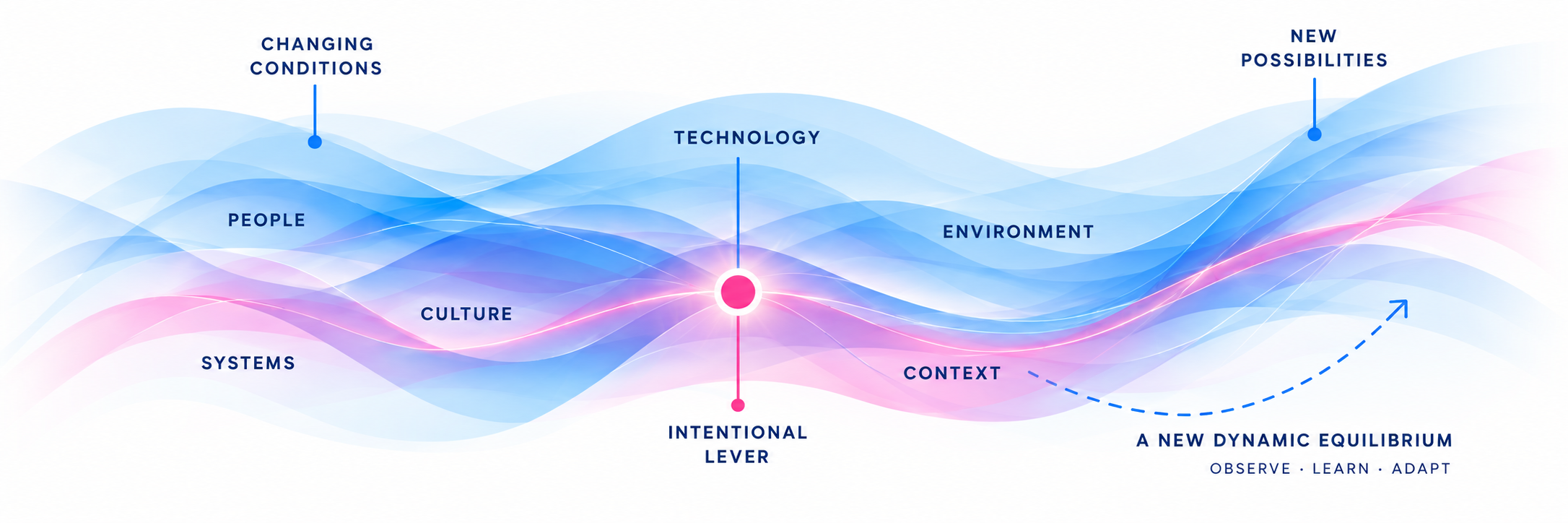
Most of us are taught to solve what is in front of us, and there is a natural logic to that. When a problem appears to be rooted in technology, we look for a technology solution; when a team is struggling, our attention may turn to leadership or the way the organization is working. In healthcare, symptoms often begin a search for a diagnosis and a path to treatment. We start with what we can see because that gives us somewhere to begin.
But what we can see is rarely the whole story.
Over the years, first as an engineer and later as a leader, I began noticing how often the thing we were trying to change was being shaped by something somewhere else. A technology could be beautifully designed and still fail to create the outcome we expected because the surrounding culture wasn't ready for it. A process that looked inefficient on paper might make perfect sense once you understood the people living inside it. Sometimes an intervention worked, but in doing so changed another part of the system in a way we hadn't anticipated.
My experiences with healthcare made this even more tangible. A human life cannot be understood as a collection of independent systems. What happens in one place can alter something seemingly unrelated, and a test result that means very little on its own can become deeply meaningful when understood alongside everything else happening to that person.
Different worlds, but I kept seeing the same underlying truth: very little exists in isolation.
That observation became the beginning of Layers & Levers.
Seeing the Layers
I think of the world around us as a set of overlapping layers. People, systems, culture, technology, environment and context are some of the ones I return to most often. Together, they help me broaden the lens and notice relationships that can be easy to miss when our attention is fixed on the most visible part of a problem.
Technology is a particularly interesting example. We often treat it as the transformation itself, especially now, as AI changes what organizations and individuals are capable of doing. Technology becomes part of a world that is already in motion, shaped by people who bring their own histories, expectations and fears, by cultures that quietly influence what is embraced or resisted, and by systems carrying the accumulated weight of decisions made long before the newest technology became part of them. The environment around all of this continues to shift, sometimes gradually and sometimes overnight, while context can make an idea that works brilliantly in one place unfold very differently somewhere else.
Once we begin to see those relationships rather than each layer on its own, the picture starts to change. What looked like a technology question may lead us somewhere unexpected, and what initially appeared to be the obvious place to intervene may turn out to be only one of several possibilities. I find myself asking what is shaping what we see, where we actually have room to influence it, and what else might move if we do.
Finding the Levers
A lever is a place where intentional action might create movement, and there are usually several available to us. Technology may be one, but some of the most consequential changes I have been part of happened when we realized the technology wasn't actually the thing holding us back. The opportunity was somewhere else, perhaps in the operating model, the autonomy people had to make decisions, an organizational boundary that no longer served us, or an assumption everyone had quietly learned to treat as permanent.
This has influenced how I think about transformation. We naturally gravitate toward the levers we understand best. A technologist may see possibilities in technology, while someone with a different experience may notice something entirely different in the same system. Each perspective can reveal something different, and sometimes the most interesting possibility emerges when those perspectives begin to overlap.
Layers & Levers asks us to widen the lens before deciding where to act.
What Happens After We Act?
This may be the part of the framework I find most important, because choosing a lever and acting on it is only one moment in a system that continues to change. People respond to what changed, technology enables behaviors we may not have anticipated, and conditions that influenced the original decision may themselves begin to shift. The intervention becomes part of the very environment we are trying to understand.
Acting also gives us information we couldn't have had before. We can see what moved and what remained surprisingly resistant, whether something changed somewhere we weren't looking, or whether a relationship that had previously been invisible has suddenly become important. That gives us something new to observe, learn from and respond to.
Over time, those interactions create a different configuration, what I think of as a new dynamic equilibrium™. The system is still moving, responding to what came before while adapting to what is changing around it. The equilibrium is dynamic precisely because those forces never completely stop.
That is why the curve in the Layers & Levers framework keeps moving.
Bringing the Idea Into the Real World
Consider what is happening with AI inside organizations today. It would be easy to look at the extraordinary pace of the technology and conclude that access to increasingly powerful AI will naturally translate into greater capability. Now imagine an AI-native college graduate joining an organization where decisions still travel through layers of approval, experimentation carries career risk, and authority remains closely connected to hierarchy.
The technology may have changed far more quickly than the environment around it.
Looking through the Layers & Levers lens opens up a much richer set of questions. The opportunity may involve the technology itself, but it may also live in how much autonomy people have, what managers reward, whether security enables responsible experimentation, how skills develop, or whether the work was designed for a world that is already beginning to disappear. Several of those forces may need to move together before the possibilities created by the technology can really emerge.
We can broaden the lens in healthcare too.
Imagine a patient moving from the first appearance of symptoms through diagnosis, treatment and recovery. We can make imaging more precise, connect clinical information that once lived in separate places, use AI to recognize patterns and eventually simulate different interventions before they happen. Those capabilities could profoundly change medicine, yet much of the patient's experience and outcome will still be shaped by what happens between them: whether the right information reaches the right clinician at the right moment, whether someone recognizes the significance of symptoms that seemed unrelated, how uncertainty is communicated when a decision has to be made, and whether what happens after treatment becomes part of what we learn next.
As our ability to create intelligence grows, the question of what we choose to do with it becomes even more consequential.
A Way of Looking
Layers & Levers is a way of broadening the lens so we can see more of what surrounds a problem, how those forces interact and where we may have room to influence what happens next.
When I am trying to understand something, I find myself wondering what sits beneath the visible problem and what else may be influencing it. I think about whose experience I may not be seeing, where there might be room to create movement, and what else could begin to shift if we choose to act there. Just as importantly, I want to know what we should keep watching afterward, because the response of the system may teach us something the original problem never could.
Sometimes broadening the lens leads to an action that feels surprisingly clear. At other times, it helps us make a thoughtful first move, learn from how the system responds and use that evidence to make the next decision better. In complex environments, that ability to learn and adapt can help us invest more intentionally as conditions continue to change.
For me, Layers & Levers is a way to stay curious about the systems we are part of, make choices with greater intention and keep learning from what happens next. What we learn may reinforce the path we are on, change the way we understand the problem, or reveal a possibility we couldn't see before.