Health & Life · Technology
Healthcare Reimagined:
Intelligence and Intention
Across the Patient Journey
A more connected, human and adaptive approach to care, where technology, people and the many layers of a patient’s life work together to support a healthier future.
Imagine two people entering the healthcare system on the same morning.
One walks into an emergency department feeling dizzy and unusually weak. Something is clearly wrong, but neither the patient nor the people around them know whether this is a routine illness or the beginning of something much more serious.
The other arrives for a scheduled appointment. Perhaps she has been experiencing symptoms for several weeks, is managing a chronic condition, preparing for surgery, or returning after treatment. Her story has accumulated across previous visits, laboratory results, imaging, medications and conversations with different clinicians.
Both need care. What they need from the system in those moments is very different.
For the first person, minutes may matter. The opportunity is to recognize risk quickly, bring in the right expertise and move toward treatment without unnecessary delay. For the second, there may be more time, but often far more information to understand. The opportunity is to see patterns across the history, give the clinician better context, explore the available choices and use the encounter for something more valuable than reconstructing information that already exists somewhere in the system.
AI could reshape both experiences, and its influence may begin long before either patient walks through the door.
What could happen if we use AI across the healthcare journey to accelerate discovery, recognize risk sooner, improve safety, give clinicians greater insight and capacity, and learn more from what happens after treatment?
The technology opens extraordinary possibilities. How we choose to use those possibilities will be equally consequential.
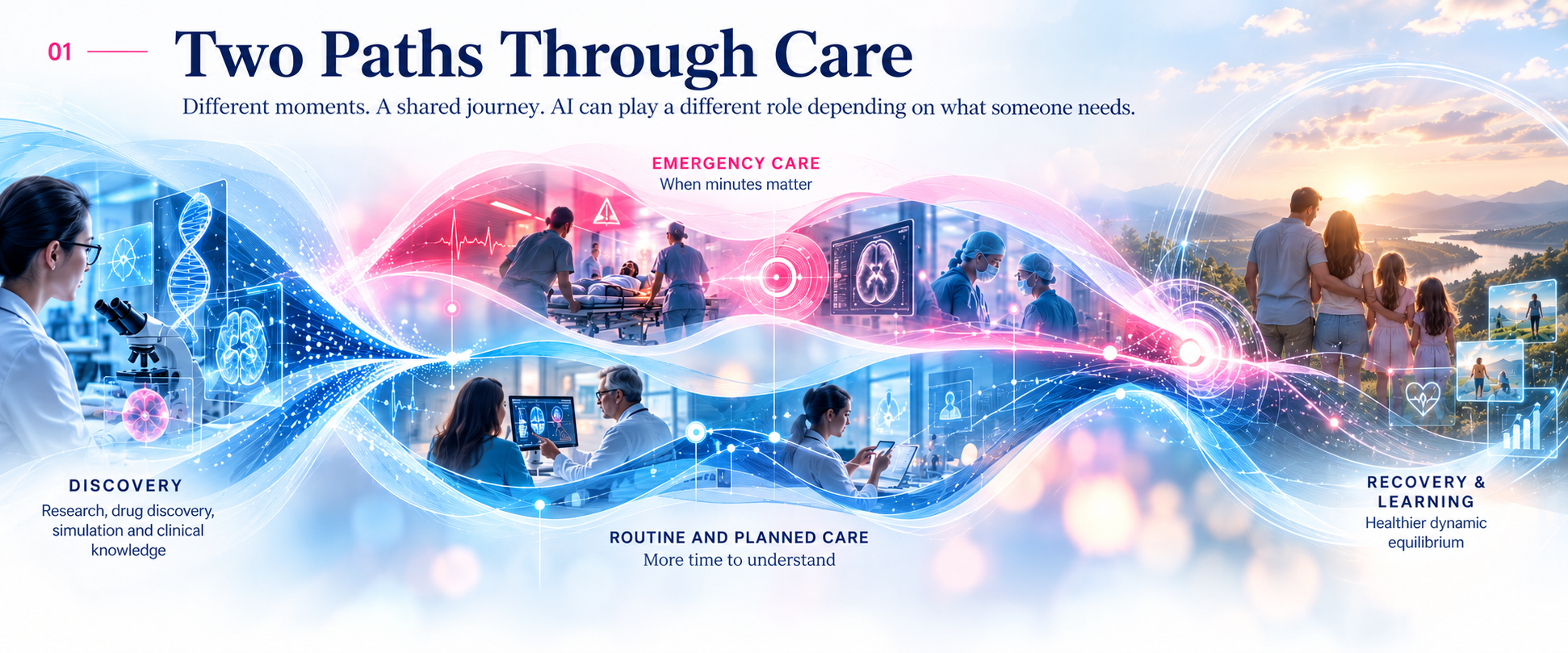
Discovery Begins Even Before Care Is Needed
For many patients, the healthcare journey begins years before they ever need a particular treatment. It begins in research.
Developing a new drug requires scientists to explore an enormous landscape of biological mechanisms, molecular structures, possible targets and interactions. AI can help researchers navigate parts of that landscape, identifying patterns, generating potential candidates and narrowing the possibilities that deserve deeper investigation.
The computational environment around that work is expanding as well. AI can work alongside high-performance computing and advanced simulation, while quantum computing may eventually contribute to particular classes of problems in molecular simulation, drug discovery and biological systems.
None of those capabilities removes the rigor required to turn a promising idea into medicine. Candidates still need experimental validation, clinical trials, regulatory review and evidence demonstrating safety and efficacy. What these technologies can change is our ability to explore the landscape, eliminate weak candidates earlier and concentrate scarce laboratory time and human expertise on the possibilities that appear most promising.
For the patient waiting for a treatment that does not yet exist, time matters here too.
When Minutes Make a Huge Difference
Now imagine arriving at an emergency department.
An AI agent could begin gathering information almost immediately: what brought you in, when the symptoms started, what changed, what medications you take, known allergies, relevant history and information already available in your medical record. As you answer, it could ask different questions based on what it is learning and begin assembling that information for the care team.
Within established clinical protocols, AI-enabled workflows could help initiate routine screening and coordinate next steps rather than waiting for every piece of information to move sequentially from one person to another.
For many people, the result may point toward something routine. For some, it won't.
Suppose the person describes sudden weakness on one side, difficulty speaking or another combination of symptoms that raises concern for a stroke. The value of AI in that moment reaches far beyond summarizing the patient's record. It could recognize that the pattern has crossed a predefined threshold, trigger an escalation pathway and bring the appropriate clinical team into the process quickly.
The same principle could apply to other time-sensitive conditions. As symptoms, vital signs, history, laboratory results or imaging become available, the picture can continue to evolve. New information may lower concern, reinforce the initial assessment or indicate that the patient needs a different level of expertise immediately.
AI can help the system keep pace with that changing picture, reducing avoidable time between arrival, recognition, escalation and appropriate treatment.
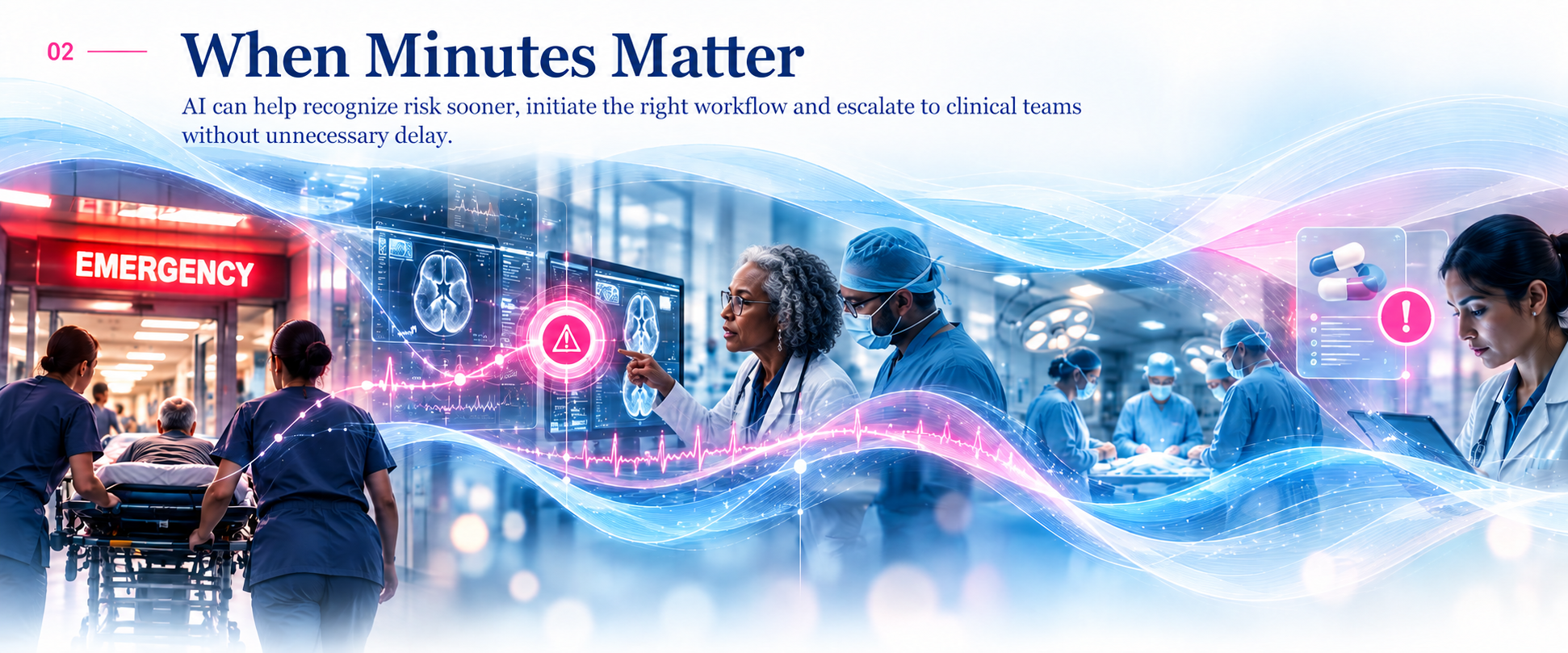
Can We Build in Another Layer of Safety?
Speed becomes valuable when it is accompanied by appropriate safeguards.
Imagine that the same AI-supported workflow reaches the point where a medication is being considered. The system can examine the medication list, known allergies, relevant laboratory values and other available clinical information before the medication is given.
A potential drug interaction could create a hard stop. So could a known allergy, contraindication, unusual dosage, unexpected laboratory result or another predefined safety condition. The workflow could require an authorized clinician or pharmacist to review the information before proceeding, with the reason for the alert and the supporting information clearly surfaced.
This creates an opportunity to design human involvement around the nature of the decision. Routine activities operating within well-understood boundaries may allow greater automation, while elevated risk, uncertainty or clinical consequence can trigger increasingly deliberate human review.
Those boundaries need to be clinically defined. We need to know who can override a system, under what circumstances, what information they see when making that decision and how the action is recorded and reviewed afterward.
Patient safety can become something we intentionally design into the workflow.
The Story Is in the Connections
Underlying both the emergency and routine-care journeys is another opportunity.
Healthcare generates an extraordinary amount of information, yet much of it still reaches clinicians and patients in fragments. Medical history may sit in one part of the record, imaging somewhere else, laboratory results accumulate over time, medications change, specialists contribute their own observations, and increasingly a person may have relevant information from devices or from what they are experiencing outside the clinical setting.
AI gives us an opportunity to bring more of those fragments into a useful clinical picture.
A medication interaction becomes easier to recognize when the current prescription is considered alongside the full medication list, allergies, kidney function and other relevant information. An emergency symptom may carry a different level of urgency when viewed alongside history and recent changes. A finding that appears unremarkable on its own may deserve another look when connected with something that happened months earlier.
This is what I think of as connected intelligence: bringing together more of the person's health story so the information can be understood in context and used when it can influence a decision.
The connection itself is not the outcome. Its value comes from what clinicians and patients are able to understand and do because of it.
My own experiences as a patient have made this particularly meaningful to me. A test result can appear reassuring while something still feels wrong. A symptom that seems unrelated may become important months later. The significance of one piece of information can change completely when someone understands what happened before it, what happened after it and what else was occurring at the same time.
That does not mean every available piece of information should automatically be collected or shared. People should have meaningful choices about the additional context they contribute, while clinicians need information presented in ways that support rather than overwhelm judgment.
Connected intelligence gives the capabilities across the patient journey something they otherwise may not have: a broader understanding of the person behind the immediate clinical question.
When There Is Time to Look Deeper
A routine or planned visit gives us more time to understand what has been happening. Before the appointment begins, AI could assemble the relevant history rather than leaving the clinician and patient to reconstruct it during the visit. Previous diagnoses, medications, laboratory trends, imaging and other clinical information could already be organized around the reason the person is there.
The patient could also contribute context they choose to share. Perhaps symptoms have changed since the last appointment. Maybe something seems to trigger them. A medication is producing an unexpected effect. Sleep has deteriorated. Heart rhythm data from a wearable shows something unusual. Recovery from a previous procedure has taken a different course than expected.
AI could help the clinician explore relationships across that information. What changed before this symptom appeared? Have these findings occurred together before? Is there something elsewhere in the history that changes how a new result should be interpreted? Is there a pattern across several encounters that deserves another look?
Healthcare necessarily relies on deep specialization, and that expertise has enabled remarkable advances in medicine. The person receiving care still experiences all of those systems together. Connected intelligence can give clinicians another way to broaden the lens around that person while preserving the clinical expertise required to determine what the information actually means.
Better understanding creates more informed choices about what happens next. Imaging is one area where AI can contribute additional insight, helping clinicians identify and quantify patterns while considering those findings alongside other evidence about the patient.
Simulation could take this further. As models become more sophisticated, clinicians may be able to explore different interventions before they happen, incorporating anatomy, disease progression and characteristics specific to the individual.
For surgery, that could eventually influence planning as well as what happens in the operating room. Today's robotic systems remain surgeon controlled, but the trajectory could move toward carefully validated forms of supervised autonomy for particular tasks. A well-defined activity such as suturing may eventually be treated differently from an unexpected anatomical finding requiring judgment in the middle of a procedure.
Evidence, risk and the nature of the task should influence where those boundaries sit. The surgeon's role may increasingly include supervising intelligent systems alongside performing the procedure, intervening when judgment, experience or changing conditions require it.
Focusing on Human Care
Some of the most meaningful changes may be much quieter. A physician sitting with a patient should be able to listen.
AI-assisted documentation can increasingly capture a clinical conversation, organize relevant information and help prepare the record while the clinician remains engaged with the person in front of them. Similar capabilities can reduce other administrative work that consumes clinical capacity.
The time returned to clinicians creates choices of its own. A person who has just received a cancer diagnosis may need something explained again. Someone preparing for surgery may need time to understand the options. A patient whose tests look reassuring while they still feel unwell may need a clinician willing to remain curious about what has not yet been explained.
Technology can create capacity. How we choose to use that capacity is one of the levers available to us.
Intelligence, Intention and Impact
Many of these possibilities depend on information, and some of that information can reveal an extraordinarily intimate picture of someone's life.
A richer understanding of health could include clinical history, imaging, medications, genetics, symptoms, information collected at home and other context a person chooses to provide.
People should have meaningful choices about what they share, when they share it and how it becomes part of their care.
Those choices need to be understandable enough to use. Someone may want heart rhythm information from a wearable available to a cardiologist while having different preferences about another use of that information. A person may choose to share additional context while recovering from surgery without assuming that every piece of information should automatically become available for every future purpose.
At the same time, requiring patients to navigate endless permissions before a clinician can see something important could create another obstacle to good care. There is thoughtful design work here: making it easy for people to contribute useful information while giving them understandable choices about how that information is used.
As our ability to know more about a person increases, our responsibility around that knowledge grows with it.
The examples throughout this journey raise practical questions. Who decides what an AI agent in an emergency department can initiate? What evidence is required before it is trusted to do so? Which symptoms or results require immediate escalation to a clinician?
Who determines that a possible medication interaction creates a hard stop? Who is allowed to override it, and under what circumstances?
What evidence should be required before an AI capability influences diagnosis, treatment planning or a surgical task? How do we know whether its performance changes over time or differs across patient populations? Who can stop its use if the evidence begins to change?
And when something goes wrong, who is accountable?
These questions bring regulation, clinical governance, privacy, security and accountability directly into the architecture of AI-enabled healthcare. Regulation has an important role in establishing protections and standards as these capabilities evolve. Healthcare organizations need governance that translates those requirements and the available clinical evidence into operating boundaries. Privacy and security need to protect increasingly sensitive information, while monitoring provides a way to understand how systems perform once they encounter the complexity of real patients and real clinical environments.
Responsibility also needs to remain clear across the technology provider, healthcare organization and clinician. Good governance makes the boundaries visible: what AI is authorized to do, what requires human judgment, how the system is monitored, who can intervene and who owns the consequences of the decisions made along the way.
What Happens During Recovery
Both care paths eventually lead beyond the clinical encounter. The emergency patient goes home, moves to another level of care or begins rehabilitation. The person who had a planned procedure starts recovering. A medication begins to take effect, or doesn't. Symptoms improve, persist or change.
Yet this part of the patient journey can become surprisingly disconnected from the intelligence concentrated around diagnosis and treatment. AI could help us learn more from what happens next.
When a person chooses to share relevant information, changes in symptoms, medication response, mobility, sleep, heart rhythm or other appropriate signals could help the care team understand whether recovery is progressing as expected and whether something deserves attention sooner.
The same information can help answer an important question: Did the intervention produce the outcome we hoped for?
For the individual, that knowledge can inform the next choice in their care. Across many appropriately governed patient journeys, it can also improve what we understand about treatments, recovery and the differences between people.
Recovery rarely means returning to some perfectly fixed state. Bodies adapt. Circumstances change. People regain capabilities, develop new ones and learn how to live within a reality that may itself continue to change.
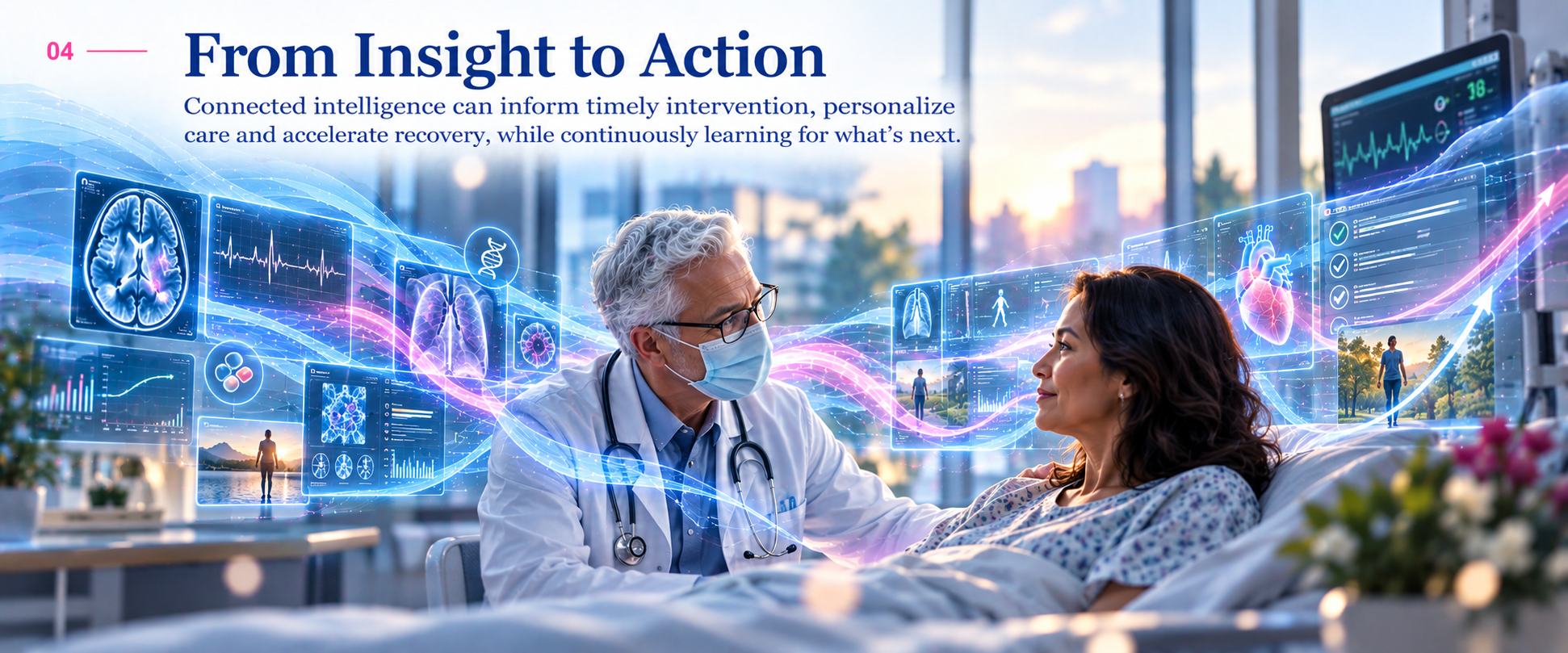
The broader context of recovery can help people find the expertise and support they need as they work toward a healthier dynamic equilibrium. And what we learn from recovery can travel back through the system, informing future decisions, future care and, eventually, future discovery.
05
Some Areas to Begin Now
Five areas where healthcare organizations can begin turning possibility into practical progress.
Patient Journey
Explore nowFind where AI can reduce friction, delay and fragmentation.
Design aroundPatient experience, clinical judgment and outcomes.
Connected Intelligence
Explore nowBring history, labs, imaging, medications and patient-provided context together.
Design aroundInteroperability, data quality, consent, privacy and security.
AI-Enabled Care
Explore nowApply AI where value can be measured across triage, insight, documentation and treatment planning.
Design aroundClear boundaries for AI action, clinician review and escalation.
Safety & Accountability
Explore nowBuild hard stops, human override and monitoring into higher-risk workflows.
Design aroundValidation, regulation, governance and clear decision rights.
Outcomes & Learning
Explore nowFollow recovery, response and longer-term outcomes.
Design aroundContinuous learning, patient choice and appropriate data use.
AI will not be the last technological shift to affect medicine. New forms of imaging, robotics, simulation, sensors and computational biology will continue to expand what is possible. Quantum computing may eventually contribute to particular problems in molecular simulation, drug discovery and biological systems that are difficult to address with today's computational approaches.
We cannot know exactly which capabilities will mature, when they will become clinically useful or what entirely new technologies will appear alongside them.
Are we building in a way that leaves room for capabilities we cannot yet predict?
The decisions healthcare organizations make today about interoperability, data architecture, security, governance and clinical workflows will influence how easily tomorrow's capabilities can become part of care. Designing for adaptability gives us room to learn without requiring us to predict exactly what comes next.
For This Patient, This Moment
AI could influence healthcare long before a person enters a hospital and long after they leave.
It could help researchers narrow the search for a therapy that does not yet exist. It could help recognize that someone arriving in an emergency department needs immediate attention and accelerate the path to the right clinical team. It could create a safety stop before a medication is given.
During a routine visit, it could help a physician see a pattern across years of fragmented information and spend more of the encounter with the person rather than the computer. It could help clinicians explore an intervention before it happens, support increasingly sophisticated surgical systems and recognize when recovery is moving in an unexpected direction.
These capabilities are very different, yet they keep bringing me back to the same question:
What does all of this mean for this patient, and how could it inform the choices available to them and their care team?
For me, that is where intelligence and intention come together. Intelligence allows us to discover more, recognize more quickly, connect what was previously fragmented and explore possibilities that would have been difficult to see before. Intention shapes what we choose to do with that capability: where AI can act, where a person needs to intervene, what information someone chooses to share, what safeguards surround a decision and how we learn from what happens afterward.
The measure of progress will ultimately be experienced by a person: whether a therapy became possible sooner, a stroke was recognized faster, an avoidable medication error was prevented, a clinician saw something that might otherwise have been missed, treatment was better informed, or recovery was better supported.
After the algorithms, models, robots, clinical workflows and data, there is still a person living the next chapter of the story.
Helping that person receive the right care sooner, make better-informed choices and move toward a healthier dynamic equilibrium may ultimately be the outcome worth designing around.