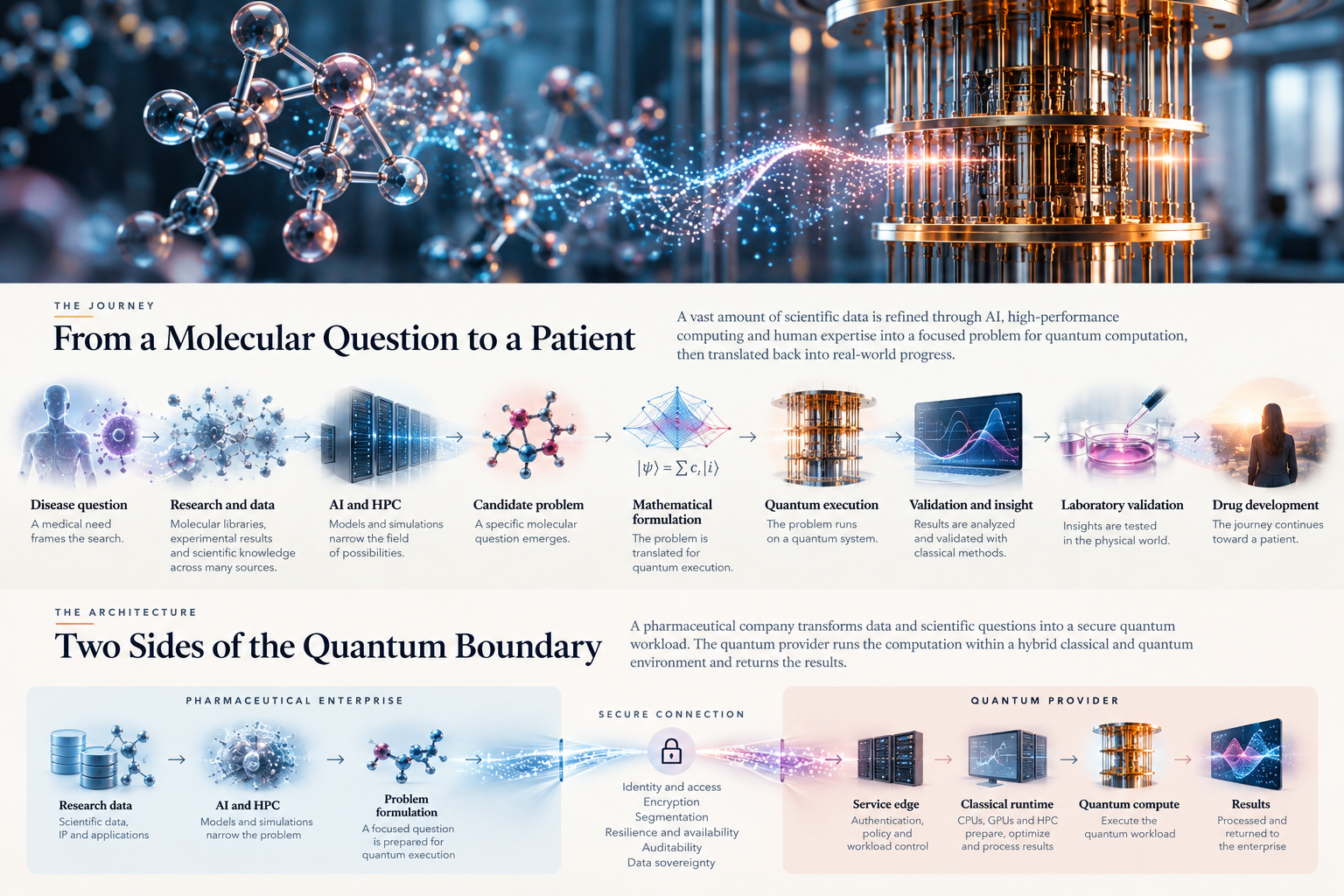
The Journey Begins Long Before the Quantum Computer
For our pharmaceutical company, the journey could begin with a question about a disease and eventually become a computational question about the behavior of a molecule.
Between those two points sit many layers of technology, science and human judgment.
Research and molecular data feed AI models and classical simulations. High-performance computing allows researchers to explore candidate structures and interactions at scale. Scientists combine those results with experimental knowledge to determine which possibilities deserve deeper investigation. Somewhere in that process, a particular question may emerge whose computational characteristics make it worth exploring through quantum.
Seen this way, quantum becomes part of a broader computational system in which different forms of computing contribute where their characteristics are most useful.
The enterprise already has data platforms, AI models, HPC environments, cloud architecture, research applications and scientific workflows. Quantum introduces another computational capability and, with it, a new architectural question: how do we recognize the problems suited to it, translate those problems into a form the technology can execute, protect them as they move and connect the results back into the systems and people making decisions?
That is a very different starting point from giving developers access to a quantum computer and waiting for use cases to emerge.
Experimentation will remain essential as the technology develops, although enterprise adoption will increasingly require organizations to connect that experimentation to problems they understand deeply. For leaders considering quantum, one of the more useful places to look may be the boundaries of their existing computational environment: the scientific, optimization or simulation problems where complexity is constraining what their teams can reasonably explore today.
What Actually Travels to the Quantum Computer?
This is where the architecture becomes particularly interesting.
A pharmaceutical company could have petabytes of research information distributed across laboratories, applications, cloud platforms and scientific computing environments, while only a fraction of that information ever needs to approach a quantum service.
AI can help narrow the search space. HPC can perform simulations well suited to classical computation. Researchers can identify the subset of a problem that warrants another computational approach. That problem can then be represented mathematically and ultimately translated into the circuits, parameters and instructions required for quantum execution.
This flow also changes the networking conversation.
The amount of information moving from the pharmaceutical company to a quantum service could be modest compared with the datasets used to produce the problem. Yet what crosses that connection may contain highly sensitive intellectual property: molecular structures, proprietary algorithms, research hypotheses or computational representations created through years of investment.
A relatively small payload can carry enormous consequence.
For infrastructure teams, capacity is therefore only one part of the design. Identity, encryption, segmentation, private connectivity, resilience, auditability and sovereignty become part of the architecture surrounding the workload.
This pattern may appear in other industries as well. A manufacturer may reduce extensive materials research into a specific simulation problem. A financial institution may transform large portfolios and market information into an optimization model. A logistics company may use classical systems to narrow an enormous routing problem before asking whether part of it is suitable for quantum computation.
The path to quantum may begin with enormous amounts of information without requiring all of that information to travel with the quantum workload.
Standing on the Other Side of the Connection
Now imagine the same transaction from the perspective of the company providing quantum computing.
A molecular problem arrives from a pharmaceutical company. Another workload may originate from a bank exploring optimization, a manufacturer investigating materials or a research institution running scientific simulations. Some clients operate primarily in their own data centers, while others may originate workloads from IBM Cloud, AWS, Azure, Google Cloud or a combination of environments.
A quantum provider needs an enterprise service boundary through which those workloads can be authenticated, authorized, governed, scheduled and routed toward the appropriate computational resources.
This is where two very different networking environments begin to appear.
Between the enterprise and the quantum service, many workloads may tolerate conventional network latency because execution can occur asynchronously. The more consequential design questions may involve secure access, availability, predictable connectivity, intellectual-property protection and geographic controls over where workloads and results are processed.
Inside the quantum environment, the characteristics can change considerably.
Quantum computation increasingly operates alongside classical computation. CPUs, GPUs and HPC systems can prepare workloads, optimize circuits, process measurements and participate in iterative computational loops with quantum processors. As those interactions become richer, the infrastructure surrounding the quantum processor begins to resemble a specialized hybrid computing environment in which CPU, GPU, HPC and QPU resources operate together.
The network supporting that environment may eventually need low latency, high performance, precise telemetry, strong resilience and considerable east-west capacity.
This is why asking how much bandwidth quantum requires has no single answer. The connection carrying a carefully formulated molecular problem from a pharmaceutical company has a very different purpose from the fabric supporting repeated interaction between classical compute and a quantum processor.
Understanding which layer of the architecture we are discussing changes the answer.
The Layers Around the Machine
This is where quantum becomes especially interesting through a Layers & Levers lens.
The quantum processor introduces a new computational lever, potentially allowing us to explore certain problems differently as the technology advances. Its usefulness, however, is shaped by the layers surrounding it: scientific knowledge, data, AI, HPC, applications, cloud platforms, networking, identity, cybersecurity, governance and operating processes.
Running through all of them is a human layer.
Someone recognizes that an important scientific question remains unresolved. Researchers understand enough about the molecule to narrow the problem. Specialists determine whether quantum computation is appropriate and translate the scientific question into mathematics. Engineers create the environment through which the workload can be executed securely. Scientists interpret the output alongside everything they already know, and eventually a laboratory tests whether the computational insight survives contact with biology.
The quantum calculation becomes one moment in a much longer journey of discovery.
Enterprise adoption will therefore require collaboration across boundaries that organizations often manage separately. Quantum specialists will need to work alongside people who understand chemistry, materials science, finance, logistics or whichever system is being explored. Cloud and infrastructure teams will need to connect new forms of compute into existing environments. Security teams will need to understand what information is moving, how sensitive it is and where it can be processed. Business leaders will need enough context to decide where experimentation deserves continued investment.
The architecture around quantum is organizational as well as technical, and the quality of those connections may influence what organizations are ultimately able to do with the technology.
Security Is Already Part of the Quantum Story
There is another reason organizations should begin thinking about quantum architecture before they have large production quantum workloads.
The progress that makes quantum computing increasingly interesting also changes assumptions underlying modern cryptography, creating a parallel journey for infrastructure and security teams.
Organizations exploring quantum services need to consider how sensitive workloads will be protected, how identities will be established, how tenants will be isolated, where information can be processed, how activity will be audited and how quantum services will connect into existing security operations.
At the same time, enterprises need visibility into where today's infrastructure depends on cryptography that will eventually transition toward post-quantum standards.
That reaches deeply into the technology estate. Certificates, PKI, VPNs, TLS, key-management systems, network devices, application interfaces and long-lived encrypted information can all become part of the transition.
The timelines for these two journeys may be very different. An organization could have relatively few production quantum workloads while already having thousands or millions of cryptographic dependencies that will eventually require attention.
Quantum readiness therefore extends well beyond access to quantum hardware.
Where I Would Start
For leaders exploring quantum, I would begin by mapping the system around the problem.
Look for areas where computational limits are constraining research, optimization, simulation or discovery, then understand how AI, HPC and existing methods already contribute and where their boundaries begin to appear. Bring domain experts together with computational specialists to determine which questions deserve further exploration and whether quantum offers an appropriate path.
From there, trace the architecture from the source of the information through computation and all the way back to the decision or physical outcome.
What data is required? What can remain inside the enterprise? What representation would need to cross into a quantum service? How sensitive is it? Where will classical and quantum systems interact? Which geographic or regulatory boundaries apply? How will results return to existing workflows, and how will they be validated before anyone acts on them?
These questions expose the layers surrounding the technology and often reveal where the most important work needs to happen.
Alongside that exploration, organizations can begin understanding the cryptographic dependencies already embedded across their environments and identifying where agility will be needed as post-quantum standards become part of enterprise infrastructure.
The result is less a single quantum roadmap than a clearer understanding of where experimentation, architecture and investment should begin.
From a Molecule Back to a Patient
Return to the pharmaceutical company.
Years of research may eventually produce a molecular question that reaches a quantum computer. The result then travels back into classical systems, scientific models and the hands of researchers who have to decide what it tells them.
Perhaps it changes which molecule they investigate next, eliminates a candidate that would otherwise have consumed months of laboratory work, reveals a property worth exploring further or simply confirms that an existing classical approach remains sufficient.
From there, the journey continues through laboratory experiments, preclinical research, clinical development and, if years of additional work succeed, toward a patient.
That full journey is what makes quantum compelling to me from an architectural perspective. A new form of computation may allow us to ask questions that were previously impractical to explore, while the ability to turn those answers into progress depends on everything surrounding the computation.
The people who understand the problem. The data accumulated over years. The AI and classical systems that narrow the possibilities. The infrastructure that connects different forms of compute. The security protecting the work. The researchers interpreting the results. The physical world where those ideas eventually have to prove themselves.
These are the layers around quantum.
Quantum gives us another lever, and perhaps over time an extraordinary one. The opportunity is to understand the system well enough to know where to apply it, what needs to move with it and how to bring what we learn back into the world.